Tribal Expressions Group Improvisational Belly Dance
Your Student Journey
If you're reading this, you're probably already curious about what's really behind Tribal Expressions, and I want to give you a look at how this program was built and why it works the way it does.
This style of belly dance draws on American tribal fusion roots, movement built for improvisation, group connection, and formation flow work. Rather than fixed, memorized routines, you create and become part of an intentional and spontaneous moving, piece of art. It means what you learn isn't just choreography, it's a vocabulary you can use to move and respond in real time, with real dancers, in real performances.
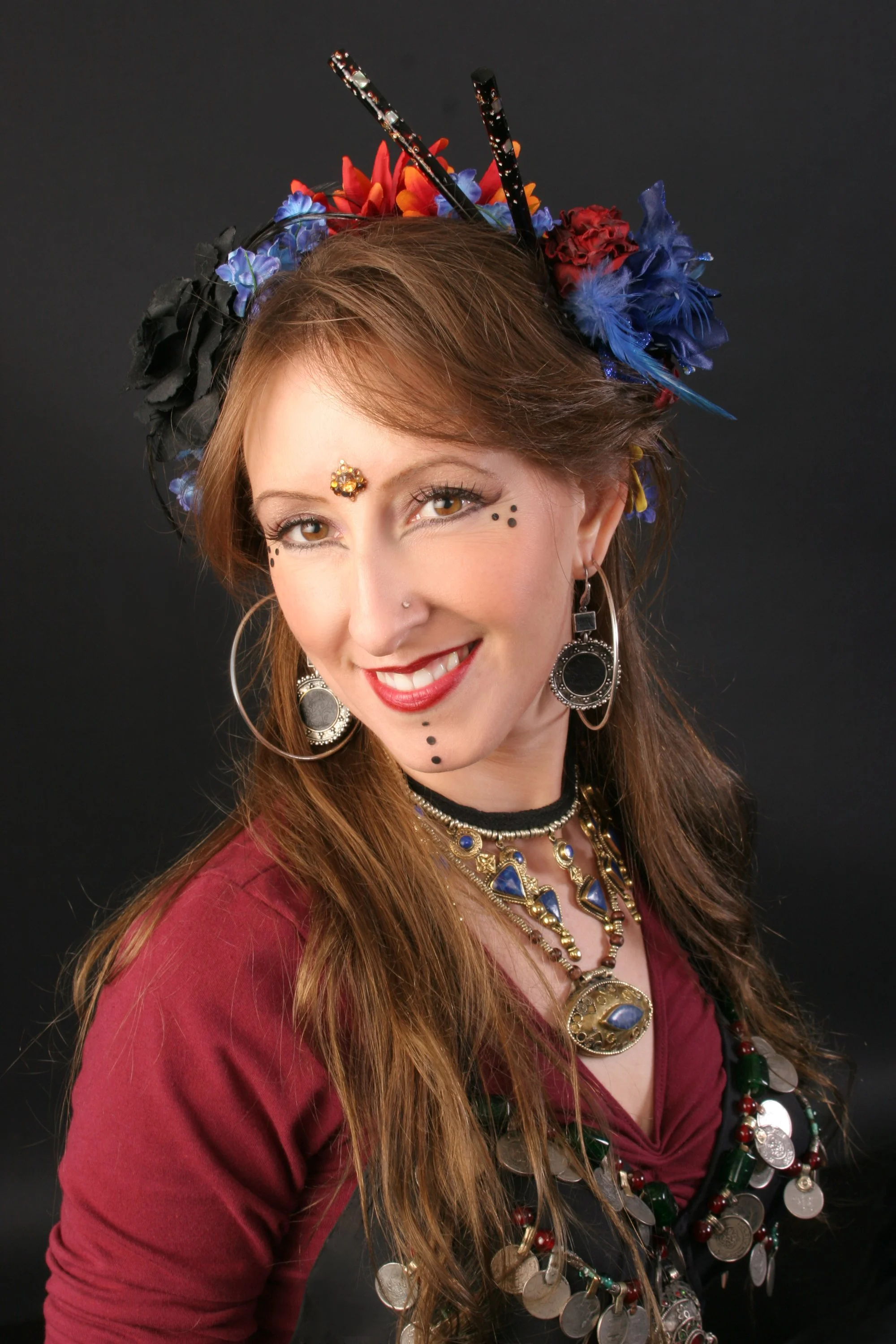
And then there’s the costuming, the flowy skirts or pantaloons, coin bras or vests, beautiful jewelry, and flowers woven into your hair. Getting dressed up isn’t something you earn later, its part of the experience from day one in Level 1, stepping into your dancer self is part of the celebration, right alongside all the hard work!
This program is built on four pillars that shape my core teaching approach, and shape every class, a deliberate teaching sequence, integration principles, safety principles, and the buildup and pacing method. In plain terms, that means new content is introduced in an order that makes sense for your body, it's layered in gradually so it actually sticks, safety is trauma-informed and considers your nervous system alongside your physical body, and pacing is designed so you're challenged without being overwhelmed. This teaching approach will allow students to progress faster with clarity and confidence.
Level One, Foundations, always stays the same. The same core terminology, foot patterns, how to travel with foot patterns, and the same anchoring combinations, session after session. That consistency is deliberate. For a brand-new student, it's where the actual language of this dance gets built, stage orientation, foot, arm, and leg positions, foot patterns, traveling foot patterns, and your first anchoring combinations, practiced until they're second nature.
But repetition means something different for the more advanced level student. Once a skill stops requiring conscious thought, new layers become available, breath woven into the movement, awareness of posture and alignment, then presence, projection, energy, and real connection with whoever's watching. So Level One isn't just where beginners start, it's a class advanced students return to again and again to keep refining, because there's always another layer to build and master.
Level Two, Connections, Level Three, Emergence, and Level Four, Artistry and Improv, each run for four sessions, and you can join in at any time! I built each one to stand alone, so it doesn’t depend on your having taken a previous session, giving every student a flexible entry point, once you're comfortable with the Level 1 content.
Tribal Expressions isn't just a belly dance class, it's a path. Built on community, connection, movement, and meaning, this program takes you on a deeper journey of self expression, kinship, and serious hip shaking fun!
If you're reading this, you're probably already curious about what's really behind Tribal Expressions, and I want to give you a look at how this program was built and why it works the way it does.
This style of belly dance draws on American tribal fusion roots, movement built for improvisation, group connection, and formation flow work. Rather than fixed, memorized routines, you create and become part of an intentional and spontaneous moving, piece of art. It means what you learn isn't just choreography, it's a vocabulary you can use to move and respond in real time, with real dancers, in real performances.
And then there’s the costuming, the flowy skirts or pantaloons, coin bras or vests, beautiful jewelry, and flowers woven into your hair. Getting dressed up isn’t something you earn later, its part of the experience from day one in Level 1, stepping into your dancer self is part of the celebration, right alongside all the hard work!
This program is built on four pillars that shape my core teaching approach, and shape every class, a deliberate teaching sequence, integration principles, safety principles, and the buildup and pacing method. In plain terms, that means new content is introduced in an order that makes sense for your body, it's layered in gradually so it actually sticks, safety is trauma-informed and considers your nervous system alongside your physical body, and pacing is designed so you're challenged without being overwhelmed. This new teaching approach will allow students to progress faster with clarity and confidence.
Level One, Foundations, always stays the same. The same core terminology, foot patterns, how to travel with foot patterns, and the same anchoring combinations, session after session. That consistency is deliberate. For a brand-new student, it's where the actual language of this dance gets built, stage orientation, foot, arm, and leg positions, foot patterns, traveling foot patterns, and your first anchoring combinations, practiced until they're second nature.
But repetition means something different for the more advanced level student. Once a skill stops requiring conscious thought, new layers become available, breath woven into the movement, awareness of posture and alignment, then presence, projection, energy, and real connection with whoever's watching. So Level One isn't just where beginners start, it's a class advanced students return to again and again to keep refining, because there's always another layer to build and master.
Level Two, Connections, Level Three, Emergence, and Level Four, Artistry and Improv, each run for four sessions, and you can join in at any time! I built each one to stand alone, so it doesn’t depend on your having taken a previous session, giving every student a flexible entry point, once you're comfortable with the Level 1 content.
Level Two, Connections, shifts the focus outward into group dynamics. You already know how to move, now you learn to move with others, attuning to the dancer beside you, responding to the group as a whole, and connecting with an audience. This is where dancing stops being a solo skill and starts becoming a shared language.
Level Three, Emergence, is where mastering the lead becomes the focus, reading cues, and timing them precisely, all while flowing in and out of the lead position to create visually interesting formations that shift and evolve in real time.
Level Four, Artistry and Improv. is where it all comes together, performance-level group improvisation, solo interpretation, deep audience connection, and full choreography/improvisation creation. You’re layering advanced group textures, building intentional musicality into every piece, and finally, you know the rules well enough the break them on purpose. This is where you fully own the floor!
Beyond level 4 is the student troupe, dancers who’ve walked this entire path and are ready to perform together, mentor those coming up behind them, keep growing alongside each other, and get to enjoy the ride!
Advancing into Levels 3, 4, and the student troupe isn’t automatic. Each has its own entry requirement, a short recorded demonstration, this could mean showing a specific skill, isolation, or texture, teaching or creating a combination, demonstrating a connective or group dynamic skill, or breaking down time and musical interpretation behind a combination choice.
Each class follows a consistent design cycle with four blocks, the opening block, the review block, the teaching, block, and the closing block. One thing you'll notice early on, especially in the opening block, is that I don't talk, I just move, and you follow. That's intentional. It’s one of four integration principles built into this program.
The first integration principle is seeing versus feeling, you'll practice a movement while watching yourself in the mirror, then turn away and feel that same movement in your body with no visual reference at all. Two completely different ways of learning, and each is vital. The second is nonverbal instruction, moments where I simply move and you simply follow, no talking, no breakdown, because sometimes words get in the way of a body actually learning. The third is storytelling as distraction, and this one's deliberate: when people are drilling something new, especially facing a mirror, the inner critic shows up fast, I can't do this, this feels wrong, I'm not good at this, and that mental spiral actually blocks the body from learning and performing. So sometimes I'll tell you a completely unrelated story while you drill, just enough to occupy your thinking mind so your body can find the movement without your brain getting in its own way. And the fourth is verbal and hands-on adjustments, the more familiar kind of teaching in a dance class, but it comes last, after your body has already had the chance to discover the movement on its own.
Together, these integration principles help your body and brain learn and absorb dance technique and concepts, more efficiently. It's a different way of learning than most people are used to, but it's remarkably effective.
Ultimately, this program is designed so you can grow further and faster than in less structured programs, simply because your body and brain are absorbing everything you are taught, and every moment in class is doing several jobs at once, building technique, vocabulary, musicality, group awareness, and performance skill.
Every dancer who walks through the door starts somewhere different — and that's exactly how it should be. This is a path, not a race. Each level builds on the one before it, giving your body and confidence time to truly absorb and develop what you're learning before you're asked to reach further.
Here's what the road ahead looks like.
Tribal Expressions - Your Student Journey and the Program
Tribal Expressions: The Deeper Journey
Level 1 - Foundations
Core Terminology
Stage Orientation
Foot, Arm, and Leg Positions
Foot Patterns
Anchoring Combinations
Level 2 - Connections
Understanding Group Dynamics
Spatial Awareness
Dancer to Dancer Connection
Music Theory
Formations
Finger Cymbals
Level 3 - Emergence
Mastering the Lead
Cue Reading
Cue Timing
Lead Changing
Challenging Combinations
Level 4 - Artistry and Improv
Performance Level Group Improvisation
Solo Interpretation
Audience Connection
Choreography Creation
Intentional Musicality
Beyond Level 4 - The Troupe
What You'll Learn
Level 1 - Foundations
This is the ground everything else stands on. You'll learn the vocabulary of the dance itself — how to read your own body, how to orient in the space, and the anchoring combinations you'll carry with you for the rest of your dancing life. Level One never gets "outgrown." Every dancer, no matter how advanced, still returns to this foundation.
Level 2 - Connections
Here, dance stops being something you do alone in a room and becomes something you share. You'll start moving with other dancers — reading each other, forming shapes together, and picking up finger cymbals and the basics of music theory along the way. This is where the social, playful heart of the dance comes alive.
Level 3 - Emergence
This is where your own voice starts to surface. You'll learn to read cues in real time, to lead as well as follow, and to trade that lead fluidly with the dancers around you. Combinations get more demanding, and so does your confidence — this level is about stepping fully into your own skill.
Level 4 - Artistry and Improv
The technical foundation is behind you — now it's about expression. You'll improvise with a group in real time, find your own interpretation as a soloist, build choreography from scratch, and let musicality guide every choice you make. This is dance as full artistic voice.
Beyond Level 4 - Troupe
For dancers who want to take their artistry into performance, the student troupe is a separate, opt-in path — complete with costuming, makeup, rehearsals, and real stage opportunities throughout the year. It isn't a fifth level to check off; it's an invitation, open to those who've built the foundation to meet it.

New Content
Monthly
Get access to Stefanie's SGI video library of quick tutorials and follow along sessions.
Cancel
Anytime
Your Questions, Answered-
Membership typically includes access to our full library of digital content—videos, courses, resources, and any new material we release while you're subscribed.
-
Definitely. You can switch plans, upgrade, or make changes to your membership anytime.
-
Yes! We’re always expanding the library with fresh content, tools, and updates to keep your learning and inspiration going strong.
-
Memberships are flexible and can be canceled at any time from your account. You’ll retain access through the end of your current billing cycle.